below is a comprehensive, locally focused article on: “How much do accountants charge in Ghana?” It uses verified sources (ICAG, research, industry articles) and includes an estimated price-range chart I generated for common services. I’ve been explicit about which statements are sourced and which are market-estimate ranges. How much do accountants charge in Ghana? — A practical, sourced guide
How much do accountants charge in Ghana? — A practical, sourced guide
Short answer (quick takeaway):
There is no single standard price — fees vary by service (bookkeeping, payroll, tax returns, audit), firm size/brand, client risk/complexity, and region. Recent guidance from the Institute of Chartered Accountants, Ghana (ICAG) introduced minimum professional service benchmarks for certain engagement types (notably for audits / public-interest entities), and market data plus academic studies confirm wide variation—from a few hundred Ghana cedis for simple monthly bookkeeping to tens of thousands for full audits of SMEs or large entities.
1) Verified facts & useful context
ICAG minimum-fee guidance: In 2024/2025 ICAG moved to a minimum professional service fee framework for audit and assurance (public interest entities and other categories). This is intended to standardize minimum hourly/engagement fees for regulated entities and help preserve audit quality. Firms still negotiate fees case-by-case, but the ICAG guidance is an important floor to be aware of. Scribd
Accountant pay levels in Ghana (market context): Average accountant base pay (a useful sanity-check to estimate firm cost structures) is reported around GH₵28k–GH₵30k per year (2024–2025 datasets), i.e., roughly GH₵2.3k per month on average — but experienced chartered accountants and partners earn much more. That matters because firms price to cover salaries, overheads, taxes and profit.
Tax compliance/SME cost studies: Academic and industry research shows SMEs in Ghana spend on tax compliance and accounting-related costs that vary widely; one study measured average tax-compliance costs and other accounting-related spending in the low thousands of cedis annually for many small firms — again underlining that accounting costs are significant but variable.
What drives audit and accounting fees: Firms consistently say the following increase fees: (a) higher risk/poor controls, (b) more complex transactions, (c) weak or incomplete books, (d) timing (busy season), and (e) the level of staff/seniority required (partner vs junior). That’s why audit fees for similar-sized businesses can differ by a large multiple.
Outsourcing trends: Large firms and reputable firms (BDO, Mazars, PwC/Forvis Mazars, Deloitte, etc.) promote outsourced accounting as an SME solution. Outsourced accounting packages are becoming common and can be priced as monthly retainers, per-employee payroll fees, or per-service fees.
2) Typical pricing models you’ll encounter in Ghana
Hourly billing — less common for ongoing bookkeeping; used for one-off advisory, forensic, or complex tax projects. Hourly rates depend on staff level (partner vs associate). ICAG minimums apply to some categories (see notes).
Fixed monthly retainer — common for bookkeeping, VAT filings, payroll and basic accounting packages. Predictable for SMEs.
Per-employee payroll fee — charged monthly per employee (useful for growing businesses).
Project / fixed-fee — for tax returns, incorporation, special engagements.
Annual audit fee — usually a fixed fee for the year’s statutory audit; often the largest single accounting cost for companies. Factors like client size, risk, and controls determine the quote.
3) Practical, evidence-based price ranges (GHS) — estimates & rationale
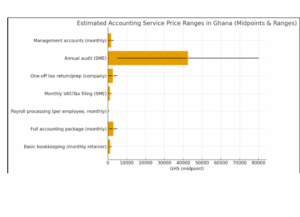
Below is a market-estimate table and a chart that shows conservative, realistic ranges for common services in Ghana. These ranges reflect (A) market practice, (B) the local wage context, and (C) published commentary about audit/assurance pricing (ICAG notes and practitioner articles). They are estimates intended for budgeting and negotiation — always request formal quotes.
Estimated price ranges (GHS) — typical small/SME client perspective:
Basic bookkeeping (monthly retainer): GH₵300 – GH₵2,000 / month
(Simple books, outsourced to small firm or bookkeeper.)
Full accounting package (monthly; bookkeeping + VAT + management accounts): GH₵800 – GH₵5,000 / month
(Depends on transaction volume and reporting frequency.) Payroll processing (per employee, monthly): GH₵20 – GH₵100 / employee / monthMonthly VAT / tax filing support (SME): GH₵200 – GH₵2,000 / month
One-off company tax return / tax prep: GH₵300 – GH₵5,000 (simple company tax returns at lower end; complex returns at higher) Annual statutory audit (SME): GH₵5,000 – GH₵80,000+ per year
(Wide band depending on size, risk, and whether firm is Big Four / large local firm or a small local practice.)
4) How to interpret the ranges — quick negotiation playbook
If a quote is very low: ask what is included. Low quotes often exclude VAT filing, payroll setup, or data-cleaning work. Hidden fees for rectifying poor bookkeeping are common.
If a quote is high (especially for audits): ask for the breakdown — hours by staff level, travel, reporting, and assumptions about the client’s internal controls. Big firms charge premium for brand assurance and deeper specialists.
The SCG Chartered Accountants
Ask about deliverables and frequency: e.g., monthly management accounts, bank reconciliations, statutory filing deadlines covered. Fixed scope prevents scope creep.
Request a phased price for poor books: Many firms will charge an initial clean-up fee, then a lower monthly retainer once books are in order.
Compare price-per-employee for payroll vs in-house: small payrolls are often cheaper outsourced; larger payrolls might be more economical in-house or with payroll software + occasional accountant oversight.
ICAG minimum professional service fee framework (announced/implemented 2024–2025) introduced minimums particularly for audits and public-interest entities. That means audit quotes for PIEs or regulated entities will be based on ICAG’s floor, and very low offers for such engagements are unlikely or non-compliant. For non-PIE clients (regular SMEs), auditors still price on risk & effort but should not undercut to unsustainable levels. Always request the firm confirm compliance with ICAG guidance where applicable.
6) How small businesses should budget (example scenarios)
Micro business (1–5 employees, low transactions): expect GH₵300–1,000/month for basic bookkeeping + VAT filing; add payroll fee per employee if needed.
Small business (6–50 employees, some inventory): expect GH₵1,000–4,000/month for a full accounting package including periodic management accounts and VAT support.
Medium business (50+ employees or higher revenues): monthly retainers can rise above GH₵4,000–10,000+; audit fees may also be substantial and need negotiation.
SME requiring statutory audit: budget GH₵5,000 – GH₵80,000+ per year depending on complexity — ask for a firm’s sample audit fee breakdown.
7) How to get reliable quotes (step-by-step)
Prepare your documents (bank statements, trial balance, payroll records, VAT returns) to let firms estimate time accurately.
Request firm proposals with a price breakdown: initial clean-up, ongoing retainer, per-service extras.
Ask which staff will do the work and hourly rates for partner / manager / senior / junior. For audits, confirm partner involvement.
Check ICAG registration and licence for the firm (the ICAG list of licensed firms can help you verify legitimacy — it is publicly maintained).
Compare 2–4 proposals and score by price, delivery, experience and references.
9) Caveats & final recommendations
The numbers above are estimates, not fixed prices. Pricing is negotiated, and many variables (industry, books quality, reporting needs, statutory complexity) change quotes dramatically. I’ve cited ICAG guidance and academic/industry research to ground the recommendations.
For an accurate budget for your firm or client, get 3 written quotes and attach a documented scope of work.
Sources & further reading (key references used)
Institute of Chartered Accountants, Ghana — course & licensing info; ICAG site (see CPD and membership pages).
ICAG / published “Minimum Professional Service Fee” guidance (published notices and practitioner commentary).
Payscale — average accountant salary in Ghana (2024–2025 estimates).
Practitioner article — How much will the audit cost? (SCG Chartered Accountants) — explains audit cost drivers and variability.
The SCG Chartered Accountants
BDO Ghana — outsourced accounting services article (SME outsourcing context).
Academic research on tax compliance costs for SMEs in Ghana (used to triangulate SME accounting burdens).